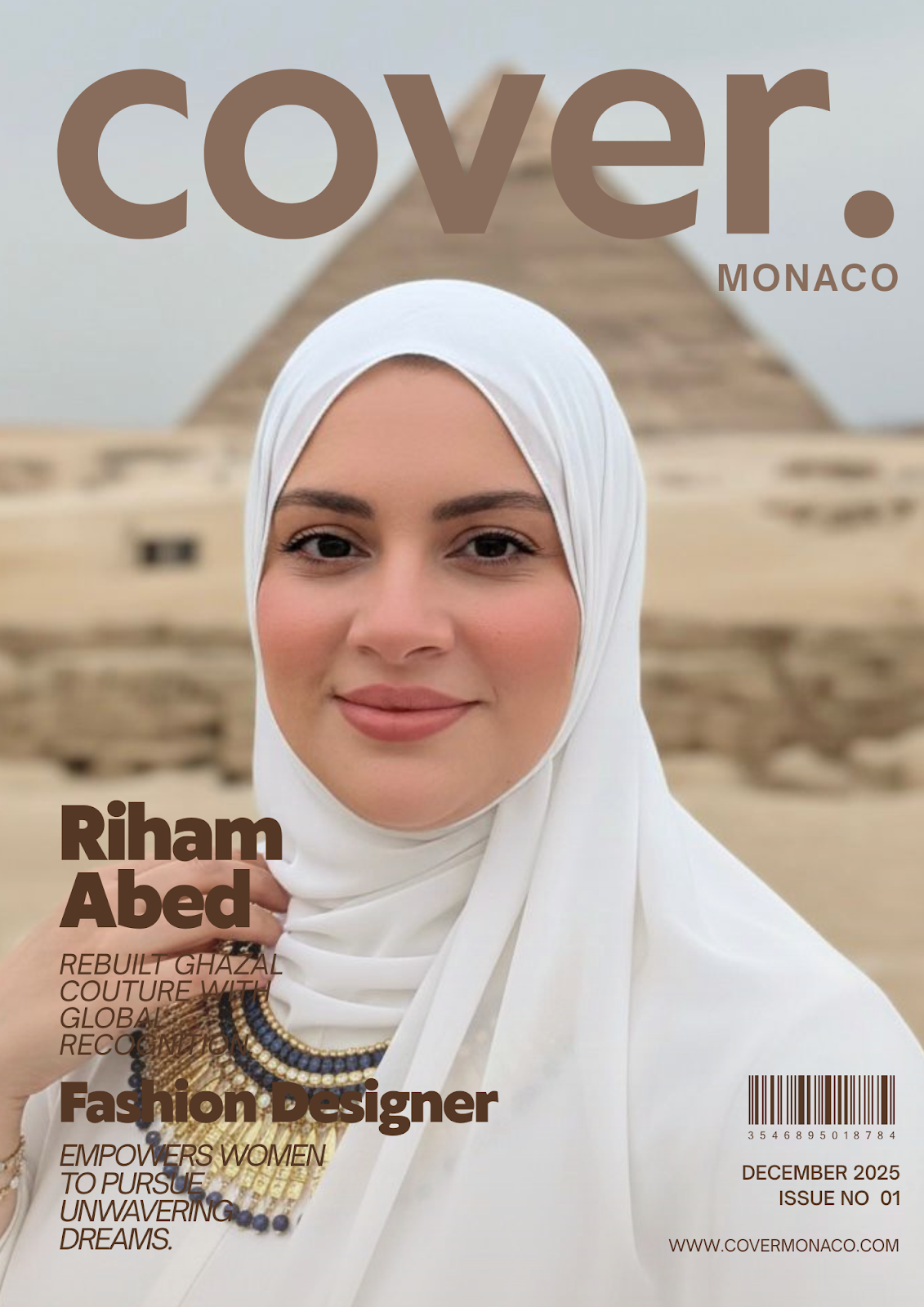
Some journeys begin with a sketch.
Others begin with a dream.
For Egyptian fashion designer Riham Abed, her journey began with both — stitched into the seams of a wedding dress she crafted with her own hands.
Born and educated in Cairo, Riham graduated with a Bachelor’s degree in Fashion Design, presenting her own wedding gown as her final project. On her wedding day, she carried that creation across borders as she traveled to Saudi Arabia to begin a new life with her husband. She arrived with talent, ambition, and passion — yet discovered a reality where her creativity had no space to breathe.
Reimagining Tradition in a World of Limits
When Riham arrived in Saudi Arabia more than twenty years ago, the fashion landscape was limited and defined by the traditional black abaya. There were no shapes, no colors, no artistic expression — and no opportunities for a young designer eager to leave her mark.
But Riham refused to let limitations become a stopping point.
“They became my strength,” she says.
She began reimagining the Eastern abaya and kaftan, elevating them from staple garments to exquisite pieces of art. Her designs introduced innovation, beauty, and individuality to a market that had long been untouched. Every abaya she created carried her signature: elegance infused with imagination, crafted to be unforgettable.
It was here, in a foreign land, that her artistic identity began to take root.
A Mother’s Battle: Courage in the Face of Crisis
Just as her brand was finding direction, life delivered its heaviest blows.
Her middle child was diagnosed with Type 1 diabetes, a moment that shattered Riham’s world. Nights became cycles of alertness — checking blood sugar every two hours, praying for stability, barely closing her eyes until dawn.
Before she could catch her breath, another storm arrived.
Her eldest son developed a severe infection: a virus in the blood, pus in the bones, and dangerous clots in his leg and lungs. What followed was a 60-day hospital battle, ten surgeries, and a mother’s endless fear. With no family nearby and only her husband and three children by her side, the weight of those days was indescribable.
“All my work stopped for more than a year,” Riham recalls.
“My heart was breaking, but I had to be strong for my children.”
Yet through the pain came clarity: she could drown in sadness — or rise again through art.
Art as Healing, Fashion as Hope
As her children healed, Riham slowly began to return to her sketchbook. Every sleepless night became an opportunity to pour her emotions into designs. Creativity became therapy. Fashion became faith.
She attempted a partnership to bring her designs to the Egyptian market, but the collaboration failed — costing her time, money, and confidence. Still, the experience taught her resilience.
“My passion kept telling me: get up, keep going,” she says.
“And so I did.”
Ghazal Couture: A Dream Reborn in the UAE
A new chapter began when Riham moved to the United Arab Emirates — the land of opportunity, innovation, and global ambition.
There, she rebuilt everything from the ground up.

Her brand, Ghazal Couture, gained powerful momentum in both the Egyptian and Gulf markets. The Dubai Economy officially registered her fashion house. International fashion committees honored her in Egypt and Dubai in 2024 and 2025. She received recognition from IIMSAM and was honored by the Goodwill Ambassador of the United Kingdom.
Today, Ghazal Couture stands as a symbol of elegance, persistence, and the limitless potential of a woman who refused to let hardship define her.
Riham’s journey is no longer local — it is global, and still rising.